
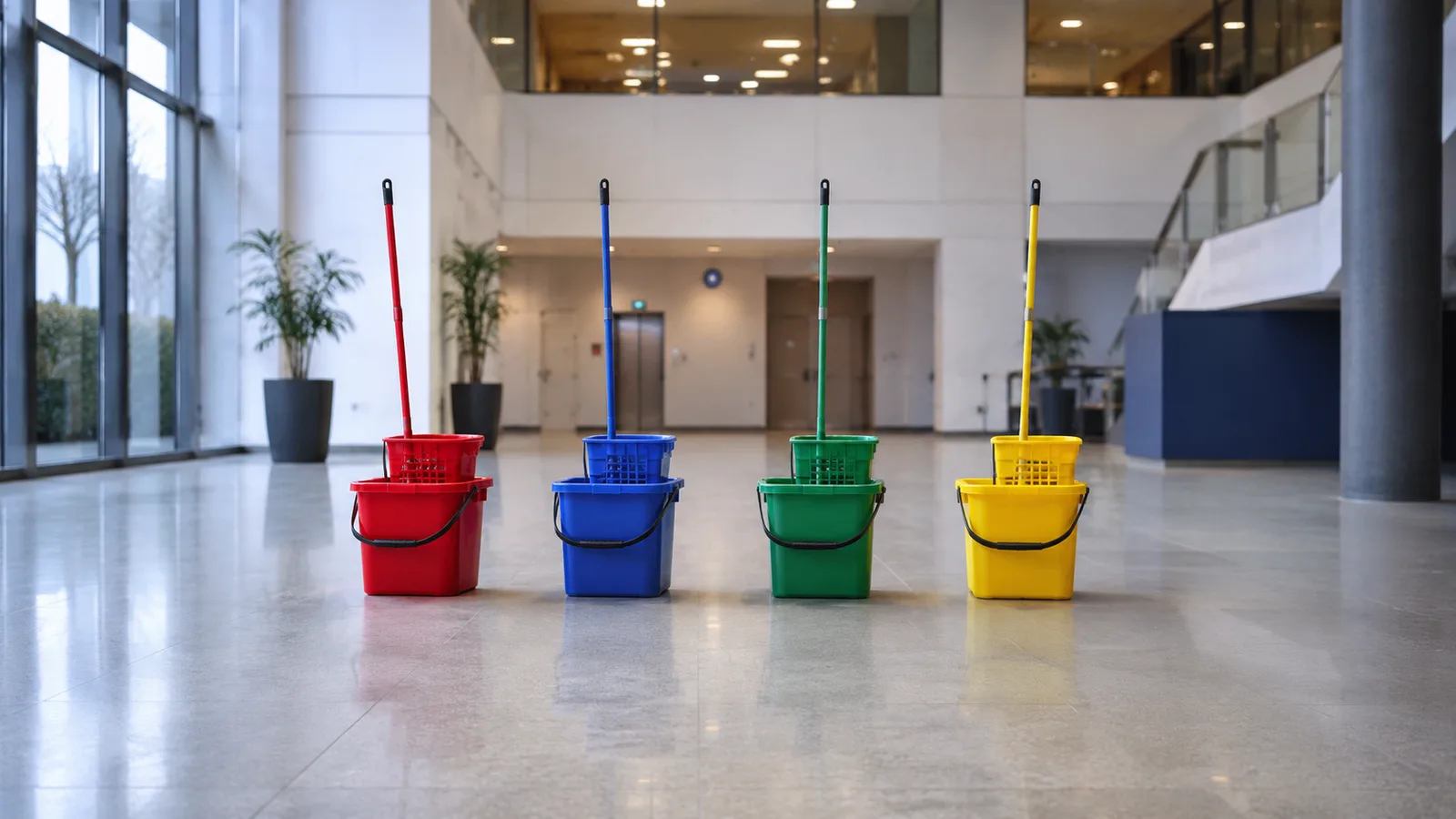
The four-colour cleaning schemes used in NHS guidance and BICSc recommendations, their scope and how they help reduce cross-contamination.
Colour coding helps keep cleaning tools assigned to appropriate areas. For example, equipment used for toilets should be kept separate from food-area cleaning. Staff need to know the scheme used at their own workplace rather than infer a colour’s meaning.
Often called COSHH colour coding, this is a cleaning and infection-control system rather than a colour scheme prescribed by COSHH. Standards and local procedures define its use in particular settings.
Where the colour code comes from
BICSc recommends a four-colour scheme for the cleaning industry: red for washrooms, blue for general lower-risk areas, green for food and bar use, and yellow for clinical use. This is guidance from the professional body, not a separate COSHH regulation.
NHS England’s National Standards of Healthcare Cleanliness 2025 set out the national healthcare scheme. They retain colour coding as a way to reduce transfer of contamination between areas.
Use the current NHS standards and the organisation’s infection-prevention procedures rather than relying only on an older NPSA notice. The 2025 NHS England standards apply to NHS trust settings; other providers should check the requirements relevant to their service.
The NHS and BICSc schemes share red for sanitary areas, green for food areas and blue for general areas. The NHS scheme specifies yellow for isolation areas; BICSc describes yellow as clinical use. There is no verified universal hospitality scheme that reverses green and yellow.
The colour code in healthcare
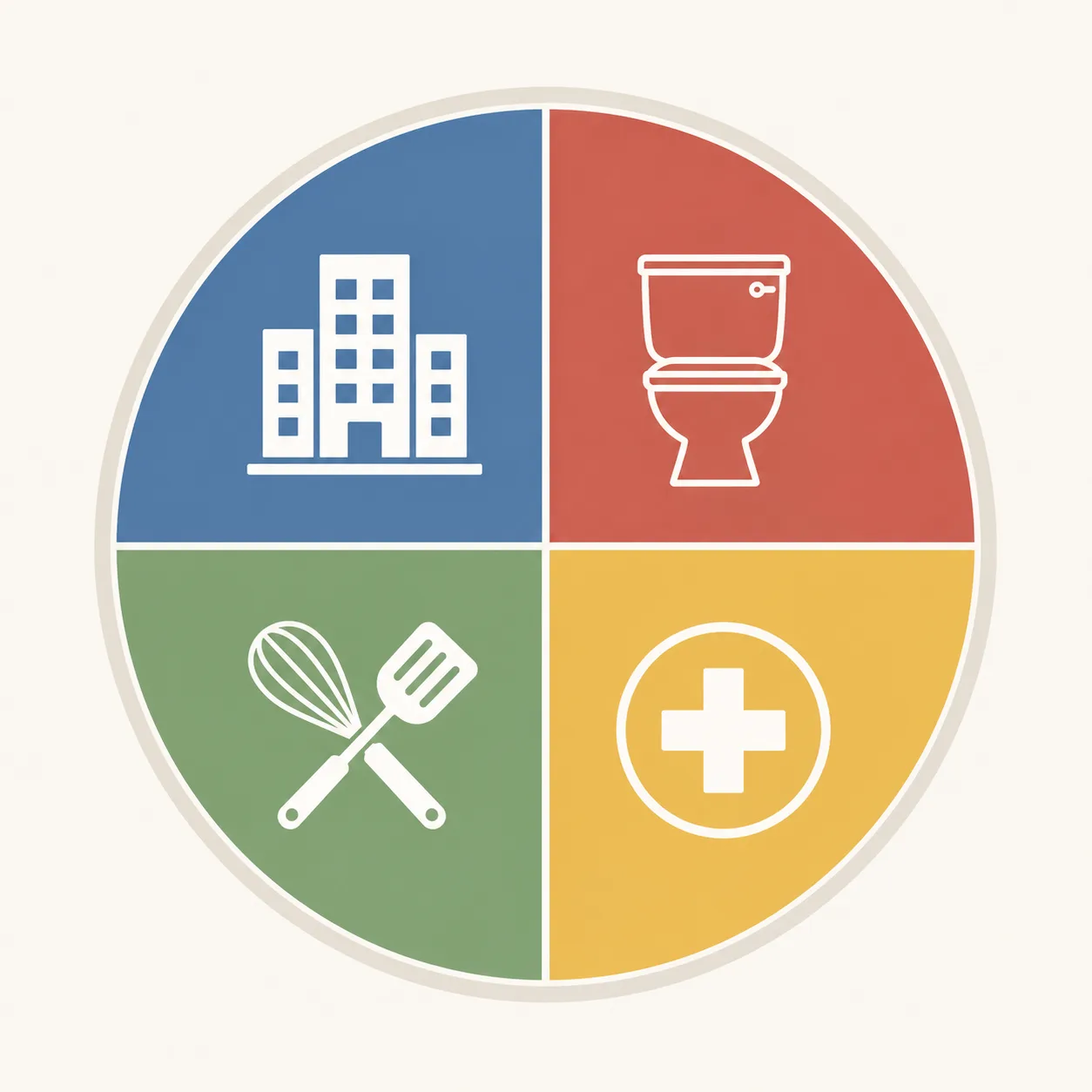
NHS England’s 2025 national scheme uses these assignments:
- Red for sanitary areas, including bathrooms, toilets, washroom floors and basins, urinals, sluices and the immediate areas around them
- Blue for general areas, including offices, corridors, waiting rooms, reception areas, communal spaces and lower-risk patient areas
- Green for catering and food preparation areas, including ward kitchens, main kitchens, dining rooms and food storage
- Yellow for isolation areas
Apply the scheme to the cleaning materials and equipment covered by the standards and local procedure. NHS guidance says cleaning chemicals do not themselves need colour coding; the scheme does not replace the separate food-hygiene arrangements for catering equipment.
Colour coding is a visible aid, supported by correct cleaning, disinfection, storage, training and supervision. Colour alone cannot prevent contamination if equipment is reused or handled incorrectly.
The BICSc scheme for general cleaning

BICSc’s recommended cleaning-industry chart, which can inform hospitality arrangements, uses:
- Red for general washrooms
- Green for general food and bar use
- Blue for general lower-risk areas
- Yellow for clinical use in healthcare
The reasoning is similar to healthcare: cross-contamination between food and non-food areas is the primary concern, with the additional consideration of preventing chemical residues from getting onto surfaces that come into contact with food. A cloth used to clean a toilet must not subsequently clean a bar surface.
Follow the documented local scheme and brief anyone moving between sites. Yellow is used for isolation areas in the NHS scheme and clinical areas in the BICSc scheme; check the scheme used at your site.
Side-by-side comparison
The NHS England and BICSc assignments compared:
| Area type | NHS England 2025 | BICSc recommendation |
|---|---|---|
| Washrooms, toilets, sanitary areas | Red | Red |
| Kitchens and food preparation | Green | Green |
| General areas (offices, corridors) | Blue | Blue |
| High-risk specialist areas | Yellow (isolation) | Yellow (clinical) |
| Front-of-house dining / bars | Green for patient food service | Green for food and bar use |
Cleaning contractors working at multiple sites should receive the relevant local instructions and know how any authorised differences are managed.
A cloth’s colour identifies its assigned use within a system. It does not establish a special isolation grade, food-safety certification or cleaning performance.
How colour coding fits under COSHH
COSHH does not prescribe these colours. Colour coding can support cleaning and infection controls, while NHS standards and local requirements determine how a healthcare organisation applies its scheme.
Where it intersects with COSHH most directly is in two areas.
Preventing chemical cross-contamination
Keep equipment and chemical residues from contaminating other areas. Use suitable products and methods and follow any required rinsing or disinfection instructions; colour coding alone does not ensure this.
Preventing biological cross-contamination
Biological exposure may fall within COSHH. Colour coding is one supporting measure alongside effective cleaning, disinfection, hand hygiene and safe equipment handling; it is not a substitute for these controls.
The COSHH risk assessment for cleaning operations should document the colour coding as one of the administrative controls in place. The substance assessments — see the COSHH risk assessment template — should reference it where the substance is used in a colour-coded area, and the training records should show workers have been trained on the convention used at their workplace.
CQC expectations and the wider regulatory picture
In England, registered providers must meet applicable infection-prevention duties under the Health and Social Care Act framework. The Code of Practice and NHS cleanliness standards help explain effective arrangements, but the legislation does not itself prescribe four particular cleaning colours.
CQC assesses safe care and infection prevention. A colour-coding issue may be relevant evidence, but a different colour does not automatically establish a regulatory breach or lead to suspension of registration.
Food businesses must prevent contamination and implement appropriate hygiene procedures. A documented colour scheme can help, but food hygiene law does not impose the unsupported yellow-kitchen hospitality mapping previously shown here.
Check the applicable national standards, contractual requirements and local infection-prevention policy before changing a healthcare scheme. In other settings, choose a clear system that prevents inappropriate transfer of equipment and train staff to use it.
Implementing colour coding in a workplace
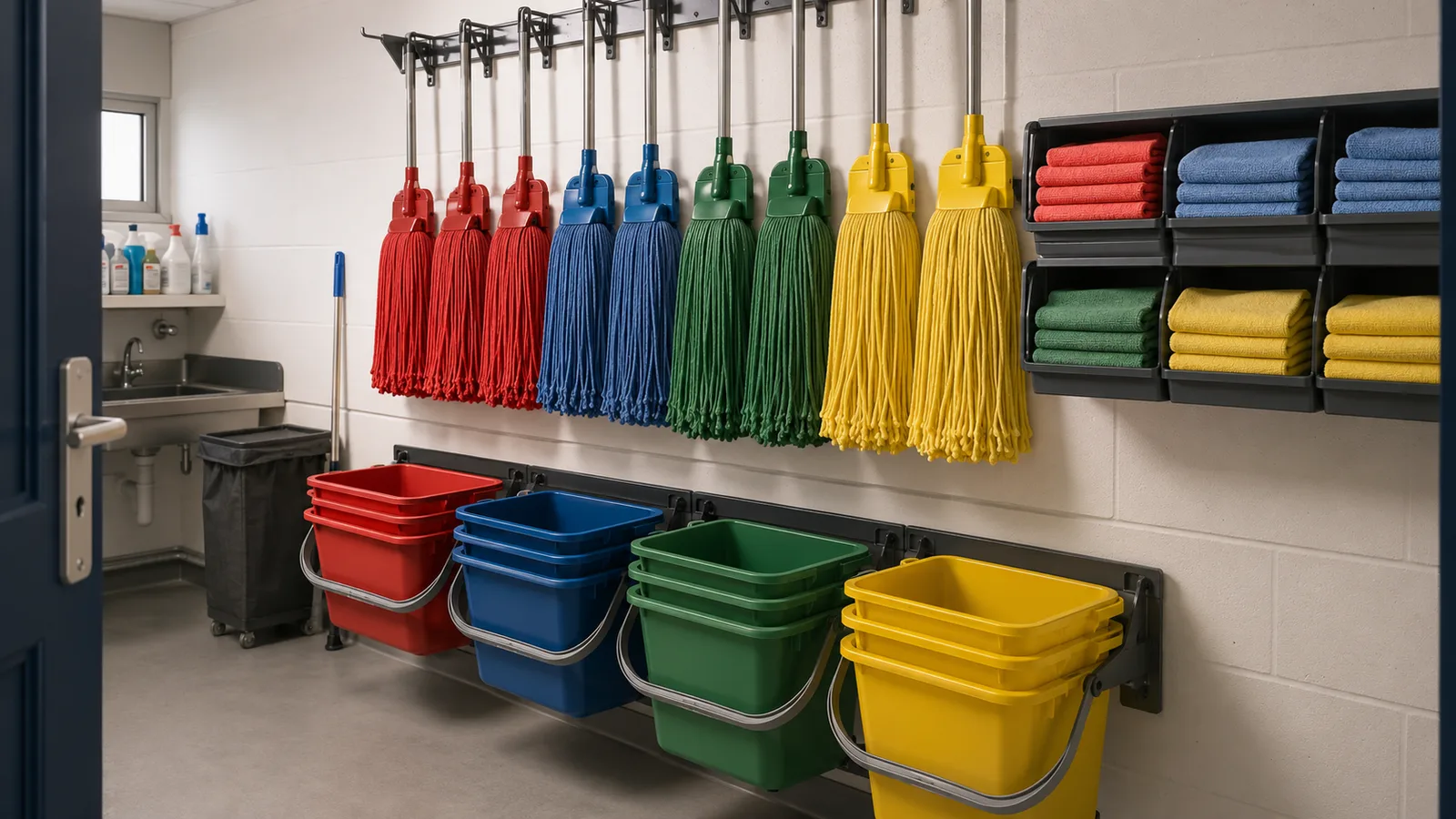
Putting the colour code into practice involves several elements working together.
Equipment procurement
Provide the cleaning tools covered by the chosen scheme and a clear way to identify and store them. Do not assume every chemical bottle, item of PPE or piece of catering equipment must use the same four colours.
Storage
Colour-coded equipment is stored in colour-coded sections, often in separate stores. The visual separation makes it harder to use the wrong equipment by mistake.
Signage
Display a clear chart or instructions where staff select and store equipment, adapted to the local procedure.
Procedures
Written cleaning procedures specify which colour to use for which task. Workers follow the procedure for each room or area.
Training
Workers learn the colour code as part of induction and refresher training. Where a worker moves between sectors with different colour conventions, the training has to address both explicitly. Structured COSHH Training typically covers colour coding as one element of safe cleaning practice, alongside chemical handling, PPE and emergency response.
Audit
Check that the correct equipment is used, cleaned and stored appropriately. Review the system through local audits and relevant infection-prevention assurance.
Investigate equipment being borrowed between areas, shortages or unclear instructions. Training, supplies and supervision should support consistent use.
Frequently asked questions
Is colour-coded cleaning a legal requirement?
COSHH does not prescribe four cleaning colours. Healthcare and food businesses have wider infection-control and hygiene duties, and NHS standards or local procedures may require the national scheme. Check the requirements for the particular setting.
What colour is used for toilets and bathrooms?
Red in the NHS England and BICSc schemes discussed here. Always follow the documented workplace procedure.
What colour is used for kitchens?
Green for food or catering areas in both schemes discussed here. BICSc also uses green for general bar use; there is no universal yellow-kitchen hospitality rule.
Can I use my own colour system?
Check the applicable standards and local requirements first, particularly in healthcare. Any system must be clear to staff and support effective contamination control; do not change colours informally.
Do CQC inspections check colour coding?
CQC considers infection-prevention and safe-care arrangements. Cleaning-equipment use can be relevant evidence, but there is no automatic enforcement outcome based on colour alone.
Related guides
- The 8 Steps to COSHH Compliance
- The COSHH Hierarchy of Control: How to Choose Controls in the Right Order
- COSHH Safety Data Sheets (SDS): What They Are and How to Use Them
Make sure your team is trained to recognise hazardous substances and clean safely under COSHH.
Explore the COSHH Training course →Sources & references
- NHS England: National Standards of Healthcare Cleanliness 2025
- BICSc: recommended cleaning colour chart
- DHSC: infection prevention Code of Practice
- CQC: infection prevention in general practice

Mark writes about workplace health & safety, COSHH and accredited online training for COSHH Training, part of Online CPD Academy.