
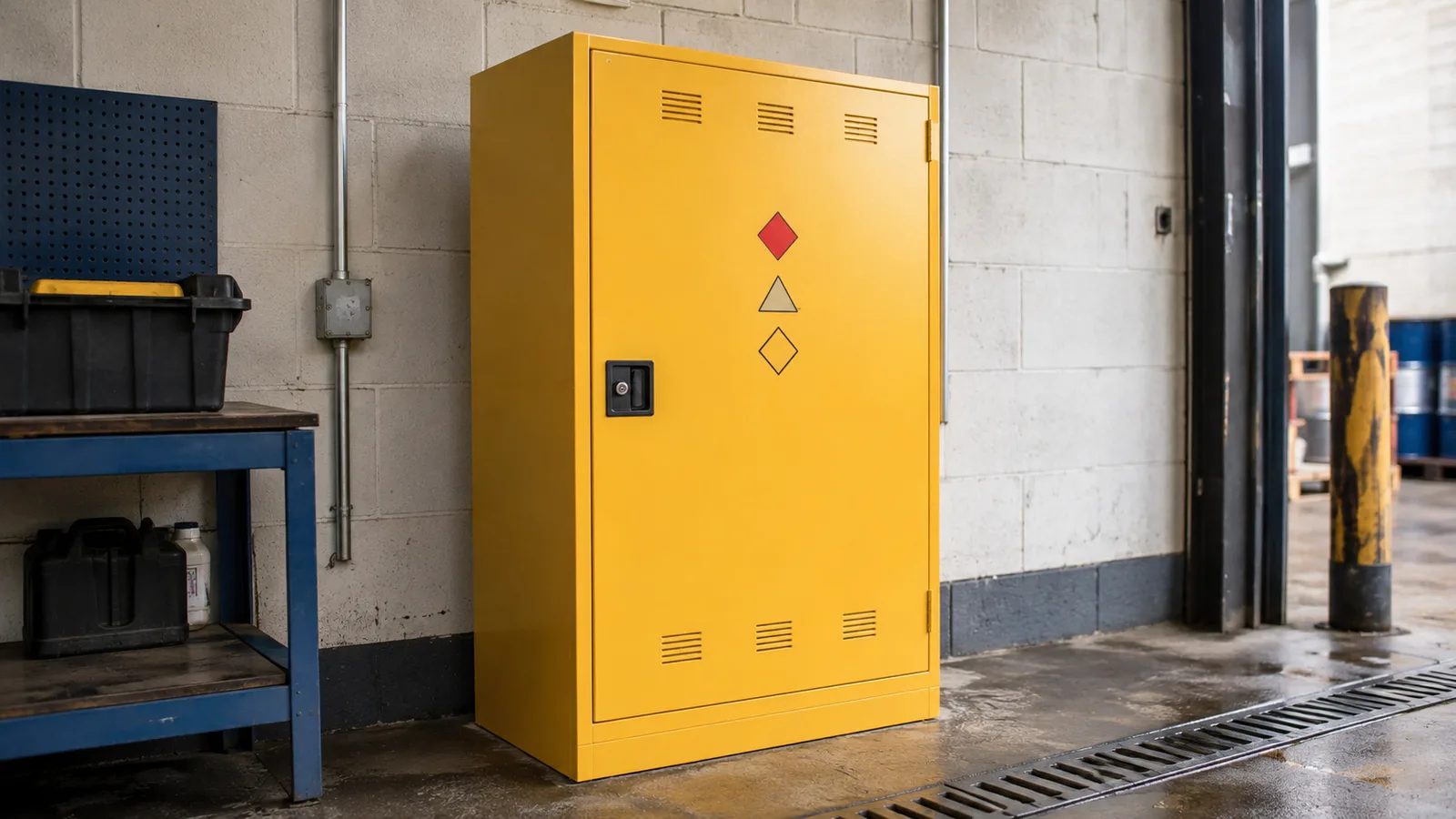
How to assess hazardous-substance storage, choose suitable cabinets and containment, and segregate incompatible chemicals.
Poor chemical storage can cause leaks, harmful exposure, fires or reactions between incompatible substances. Storage arrangements should form part of the risk assessment and be checked in use.
This guide concerns Great Britain’s COSHH and DSEAR framework. HSE guidance and relevant product standards help with storage design, but requirements depend on the substances, quantities and premises. Northern Ireland has separate regulations.
What COSHH actually requires for storage
A point of accuracy worth getting clear: COSHH itself doesn't prescribe specific cabinets. The regulations set outcome-based requirements through Regulation 7 (prevent or adequately control exposure), Regulation 9 (maintain control measures in efficient working order) and Regulation 13 (emergency arrangements). The specifics — what fire rating, what sump capacity, what segregation distances — come from separate guidance and standards.
This matters because some retailer pages imply that COSHH "requires" yellow cabinets or specific products. That's not how the regulations work. The legal duty is to store substances in a way that prevents harm; the cabinets, signs and procedures are the means.
The standards that fill in the practical detail are:
- HSG51 — HSE's guidance on the storage of flammable liquids in containers
- L138 — the Approved Code of Practice for DSEAR
- BS EN 14470-1 — the British and European Standard for fire-resistant cabinets for flammable liquids
- BS EN 14470-2 — the equivalent standard for gas cylinder cabinets
Assess the particular storage risks and provide effective controls. Standards and guidance can help demonstrate that a design is suitable, but meeting one product standard does not guarantee compliance with every workplace duty.
Features to assess when choosing a storage cabinet
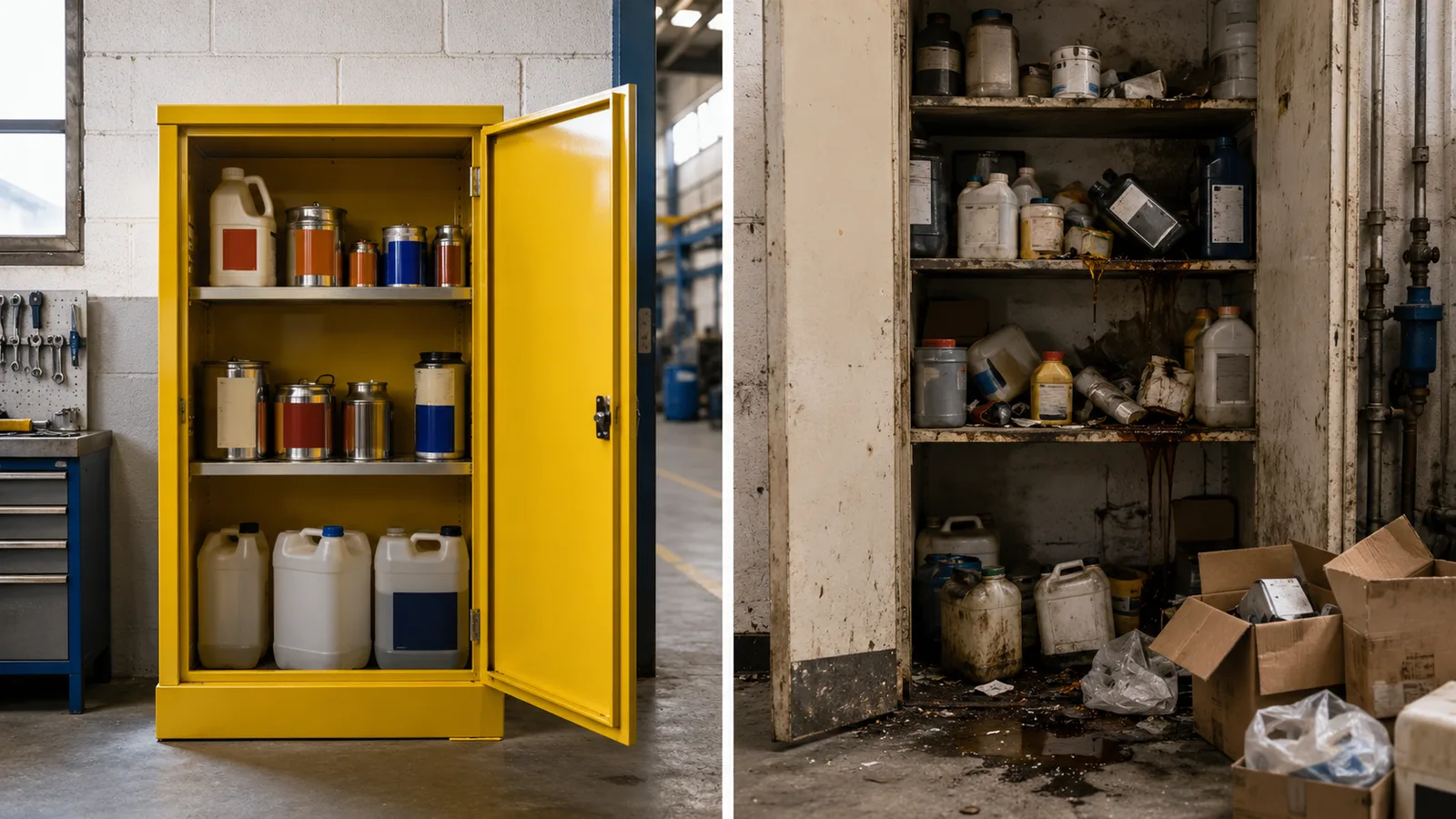
The following features need to suit the substances and location; they are not a universal specification for every hazardous liquid.
Construction
Use materials resistant to the chemicals stored and construction that prevents leakage. Flammable-liquid cupboards or bins need suitable fire-resisting construction, close-fitting doors and sound joints. A generic steel cabinet is not necessarily suitable for every corrosive substance.
Sump (bunded base)
For flammable-liquid cabinets or bins in workrooms, HSE guidance specifies spill retention of 110% of the largest vessel normally stored. A 25-litre vessel therefore needs at least 27.5 litres of retention. Other storage arrangements may have different or additional containment requirements.
Ventilation
Assess ventilation of the store and any cabinet with competent advice. Follow the cabinet manufacturer’s design and installation instructions. Do not add vents or discharge harmful vapour into the workroom, and do not compromise the cabinet’s fire resistance.
Locking
Restrict access as required by the assessment. A lock may be appropriate, but key arrangements must allow authorised users to follow the safe system without bypassing storage controls.
Signage
Provide clear identification and suitable hazard warnings where required. Labels on containers and signs for stores serve related but different purposes; select them using the assessment and the Safety Signs and Signals requirements.
Fire rating
Flammable-liquid storage requires suitable fire resistance. HSE explains that standards such as BS EN 14470-1 can exceed the minimum construction guidance and are not universally mandatory. Select a suitable design for the risk rather than assuming one cabinet rating is legally required in every workplace.
Yellow is a common cabinet colour, not a COSHH legal requirement. Suitability depends on construction, compatibility, containment, siting and use, rather than colour.
Volume limits for flammable liquid storage
HSE recommends keeping only the minimum needed for frequent activities or approximately half a day or one shift in the workroom. Its recommended cabinet/bin maxima are:
- 50 litres of extremely or highly flammable liquids, and liquids whose flashpoint is below the workroom’s maximum ambient temperature
- 250 litres of other flammable liquids with a higher flashpoint up to 60°C
These are recommended maxima representing good practice, not absolute statutory quantity limits. Assess the total storage and activity in the workroom, including the consequences of a spill and safe escape.
A need to exceed the recommendations requires a robust risk-based justification. Dedicated stores or outdoor storage should be considered; a higher-rated cabinet is not automatically a substitute for suitable separate storage.
Sumps and secondary containment
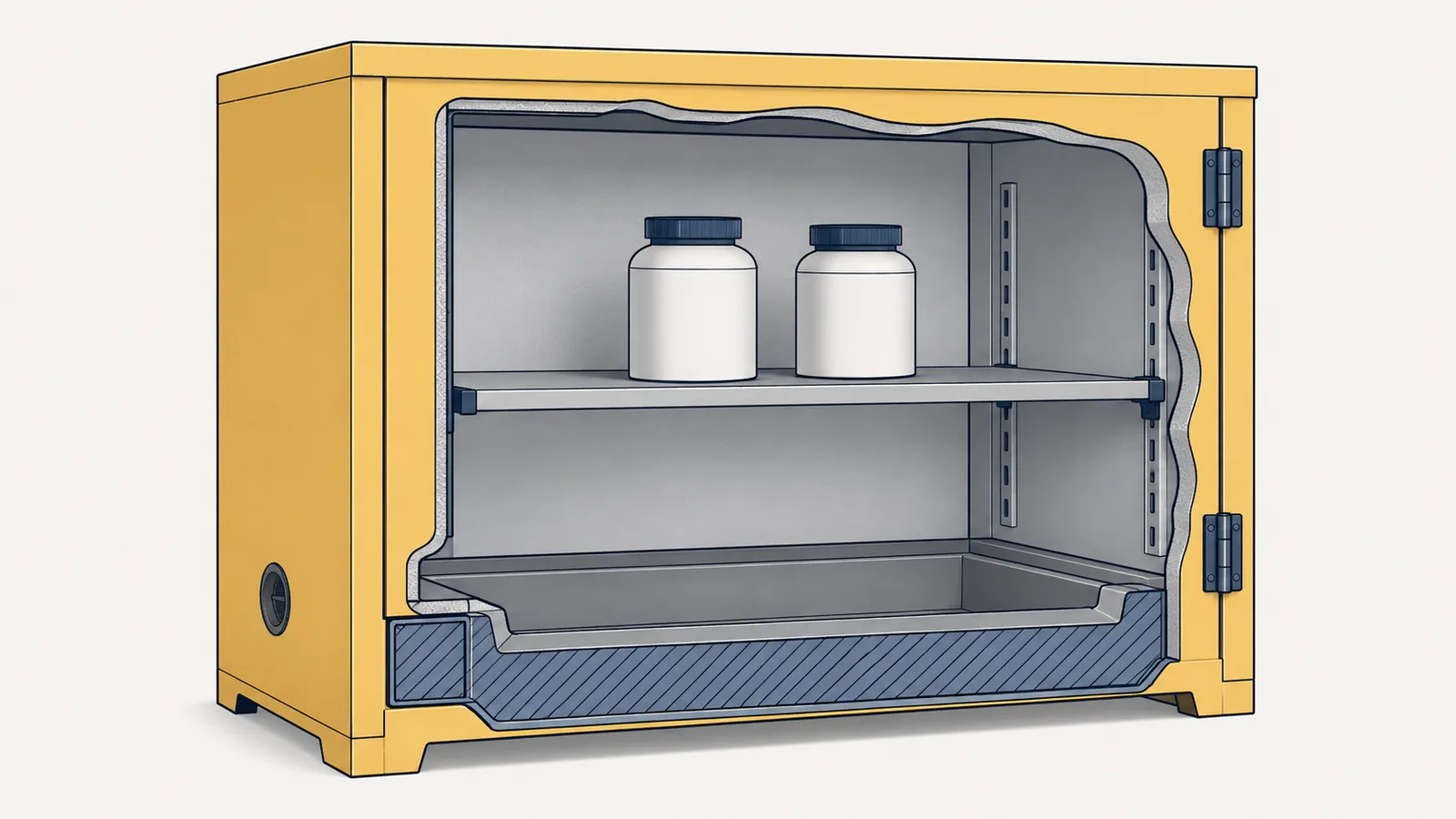
The 110% guidance above concerns flammable-liquid cupboards and bins. Do not assume it governs every chemical store or tank. Size and design other containment for the credible releases, chemical compatibility and applicable environmental rules.
For storage outside a cabinet — drums on a hard standing, IBC tanks in a chemical store — secondary containment is provided by bunded floors, drip trays or external bund walls. The same principle applies: capacity sized to contain a credible single failure, with no drains running out of the bunded area into the wider environment.
Segregating incompatible substances
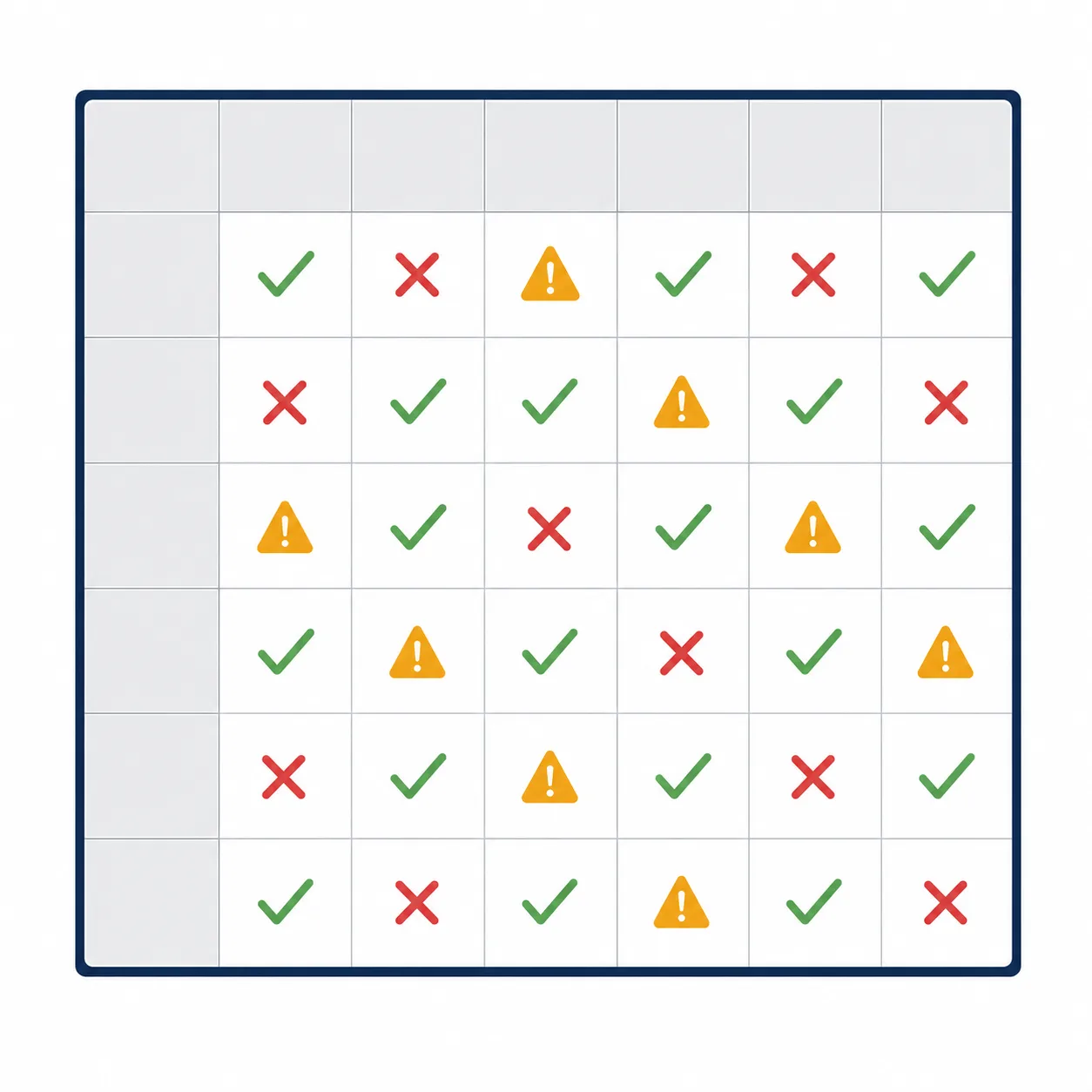
Incompatible substances can react if containers leak or fail. Use the actual safety data sheets and the storage assessment to prevent contact, including contact between spills.
The substances that need to be segregated fall into a few major incompatibility groups:
| Substance category | Must be kept away from | Why |
|---|---|---|
| Acids (mineral and organic) | Alkalis, oxidisers, cyanides, sulfides | Vigorous reactions, possible release of toxic gases (e.g. HCN, H₂S) |
| Alkalis (bases) | Acids, organic peroxides | Exothermic reactions |
| Oxidisers (peroxides, perchlorates, nitrates) | Flammables, organics, reducing agents | Fire and explosion risk |
| Flammable liquids | Oxidisers, ignition sources | Direct fire and explosion risk |
| Water-reactive substances (alkali metals, calcium carbide) | Water, aqueous solutions | Often spontaneous ignition or gas release |
| Toxic substances | Foods, food packaging, water supplies | Cross-contamination risk |
| Bleach (sodium hypochlorite) | Acids, ammonia, alcohols | Acids can release chlorine; ammonia can form harmful chloramines. Other incompatible mixtures can also be dangerous |
| Cyanides | Acids | Releases hydrogen cyanide gas |
Use the actual inventory to determine segregation. A fixed number of cabinets cannot establish safety. Incompatible substances need arrangements that prevent contact, including separate suitable spill containment where required.
For larger sites with more complex inventories, a formal segregation matrix is part of the safety management system. The matrix lists every substance stored on site and indicates which can be co-located. The substance safety data sheet (Section 7 — handling and storage, and Section 10 — stability and reactivity) is the source for the segregation requirements of a particular substance.
The risk assessment for each substance — see the COSHH risk assessment template for the field structure — should record the segregation requirements explicitly.
Container labelling
Keep supplier labels legible and ensure workplace containers are identifiable with suitable hazard information. Labelling and limited-use exceptions depend on the applicable rules and arrangements. Never use food or drink containers or leave a chemical’s identity ambiguous.
Check decanted containers during routine inspections. Workers should not have to guess what a liquid contains; quarantine unidentified material and arrange competent identification or disposal.
Signage at the storage location
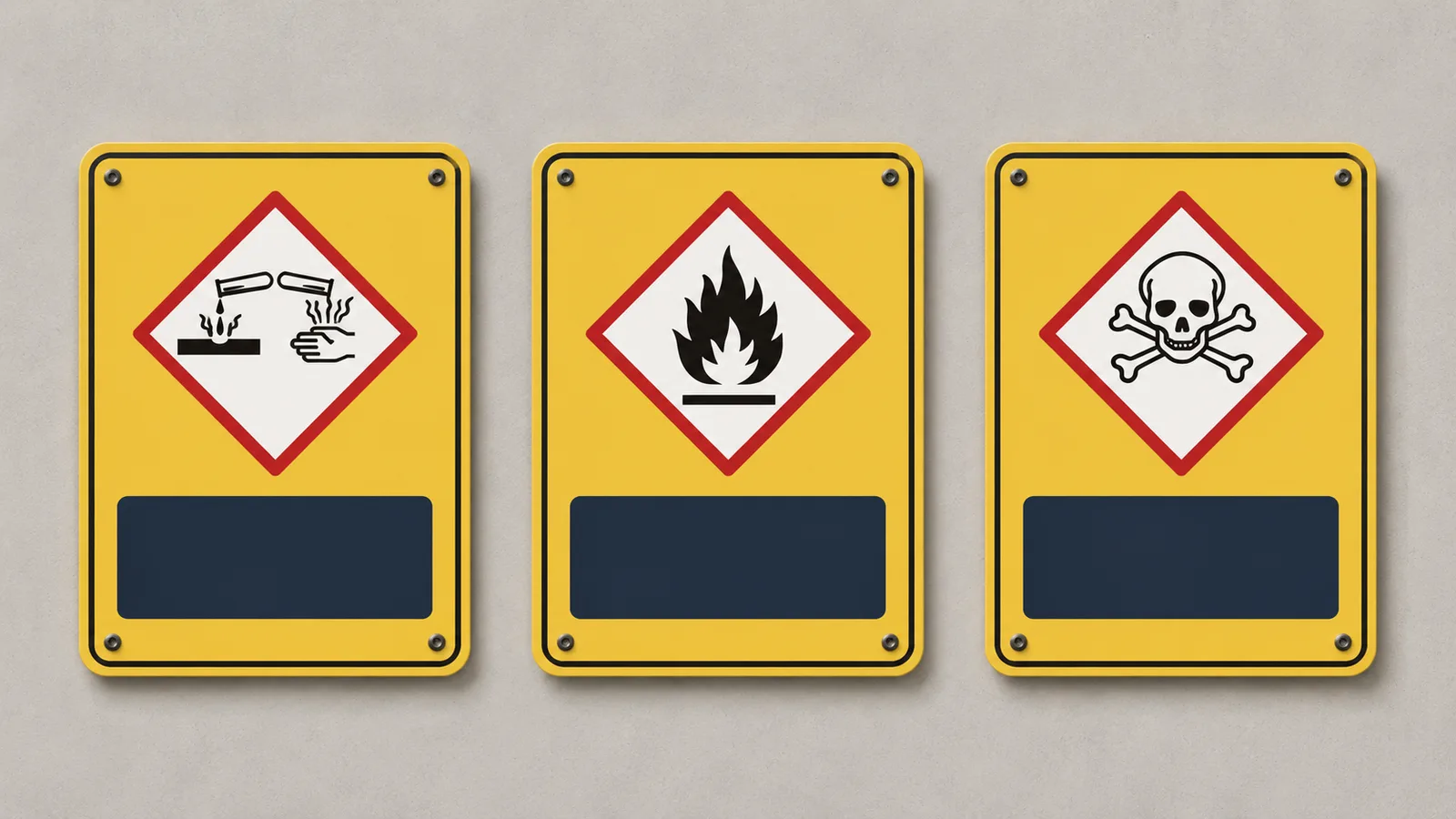
Provide safety signs where risks cannot adequately be avoided or reduced by other means and where the specific container or storage-sign rules apply. Significant hazardous-substance stores may need suitable warning signs unless individual labels provide adequate warning.
Use appropriate fire, ignition-source and hazardous-area signs where the assessment requires them. A single sign does not replace safe storage and ignition control.
Siting of cabinets and stores
Where to put a COSHH cabinet matters as much as what the cabinet is. The siting rules are mostly common sense applied consistently:
- Away from ignition sources — heaters, electrical distribution boards, hot equipment
- Away from fire exits and escape routes — a substance store next to the only fire exit defeats its own purpose
- Away from high-traffic areas where a damaged cabinet could be impact-damaged
- Provide suitable ventilation for the assessed storage arrangement without defeating fire-resisting construction
- Away from food preparation, food storage and water supplies — to prevent cross-contamination
- Accessible to the people who need it — workers shouldn't be tempted to keep substances at their workstation because the cabinet is too far away
For external chemical stores, additional considerations apply: distance from buildings (separation reduces fire spread risk), distance from boundaries (and from neighbouring properties), drainage that doesn't discharge into watercourses, and security against unauthorised access.
Inspection and maintenance
Inspect cabinets regularly at a frequency suited to the hazards, usage, condition and manufacturer’s instructions. There is no universal monthly or quarterly COSHH cabinet interval.
The inspection checks the following:
- Door seals intact and undamaged
- Sump empty, clean and undamaged
- No leaking containers inside
- Labels on cabinet exterior still visible
- Lock working and the key controlled
- No incompatible substances inside
- No expired substances or substances no longer in use (these often accumulate)
- Substance list (or COSHH register) up to date
Maintain ventilation used as an exposure control. LEV normally needs thorough examination and testing within 14 months, with shorter intervals for specified processes or where the assessment requires them.
DSEAR alongside COSHH
COSHH addresses health risks; DSEAR addresses relevant safety risks such as fire and explosion. Assess both where applicable. The findings can be combined or cross-referenced; the law does not require one particular document arrangement.
The DSEAR assessment will consider:
- Whether the storage area could form an "explosive atmosphere" (a vapour-air mixture that could ignite)
- Sources of ignition — electrical equipment, hot surfaces, static electricity
- Zone classification (where required) — Zone 0, 1 or 2 for vapour or gas atmospheres
- Suitable equipment and ignition controls for any classified hazardous area
There is no universal small-volume exemption from considering hazardous areas. Assess whether an explosive atmosphere can occur and classify relevant areas where required, using competent advice.
Training for workers using stored substances
Storage isn't only about cabinets and signs — it's about the workers who use the substances. Regulation 12 of COSHH requires workers to be trained on the substances they handle, including how they're stored, what segregation rules apply, and what to do if a substance is damaged, leaks or is spilled. That training is part of structured COSHH Training, which typically covers symbol recognition, segregation, and emergency response together.
Workers need to understand the actual storage rules, incompatible substances and emergency actions. For example, instructions should explain why bleach and acidic cleaners must not be mixed.
Frequently asked questions
Does COSHH require a yellow cabinet?
No. Cabinet colour does not establish compliance. Select storage appropriate to the chemical, quantity, location and assessed risks.
What's the difference between a COSHH cabinet and a flammables cabinet?
COSHH cabinet is a general commercial description, not one legal specification. Flammable-liquid storage additionally needs suitable fire-resisting construction. Check the manufacturer’s performance information and the workplace assessment.
Can I store acids and alkalis together?
Segregate incompatible acids and alkalis so that leaks cannot mix. Separate shelves alone may be inadequate, especially with shared spill containment. Use the substances’ SDSs and competent storage advice.
How much spill containment do I need?
For flammable-liquid cabinets or bins in workrooms, HSE recommends retention of 110% of the largest vessel: 27.5 litres for a 25-litre vessel. Check separate requirements for other storage types and substances.
Do COSHH cabinets need ventilation?
Ventilation needs depend on the substances and installation. Follow the assessed design and manufacturer’s instructions; do not improvise cabinet vents or release vapour into occupied areas.
How often should I inspect a COSHH cabinet?
Choose a suitable inspection interval from the risk and manufacturer’s instructions. COSHH does not set a universal cabinet interval. LEV used for exposure control has separate examination and test requirements, normally no more than 14 months apart.
Related guides
- COSHH Cleaning Colour Codes Explained
- The 8 Steps to COSHH Compliance
- The COSHH Hierarchy of Control: How to Choose Controls in the Right Order
Make sure your team is trained to store and handle hazardous substances safely.
Explore the COSHH Training course →Sources & references
- HSE: flammable-liquid storage in workrooms
- HSE: storage of flammable liquids in containers
- HSE: DSEAR Approved Code of Practice
- HSE: safety signs and signals
- HSE: COSHH Approved Code of Practice

Mark writes about workplace health & safety, COSHH and accredited online training for COSHH Training, part of Online CPD Academy.