

A scope guide to the Control of Substances Hazardous to Health Regulations — which substances fall under COSHH, which sit under separate regulations, and the edge cases that catch people out.
COSHH covers substances hazardous to health, including purchased products and materials generated by work. This guide explains the Great Britain Regulations 2002; Northern Ireland has separate regulations. Lead, asbestos and radiation risks have specific regimes, and the precise exclusions matter where a material has more than one hazard.
This page covers the scope question directly. For the wider picture on COSHH, see what COSHH is. For the regulations themselves, see the COSHH Regulations 2002.
The legal definition
Regulation 2 defines a substance hazardous to health. The main categories include:
- Substances or mixtures meeting the specified health-hazard classification criteria
- Substances with a workplace exposure limit listed in EH40
- Biological agents
- Dust at the airborne concentrations specified in Regulation 2
The definition also covers other substances creating a comparable health hazard because of their properties and the way they are used or present at work. A warning label is not a prerequisite, and the exclusions in Regulation 5 must also be considered.
What COSHH covers
In practical terms, the regulations cover the following.
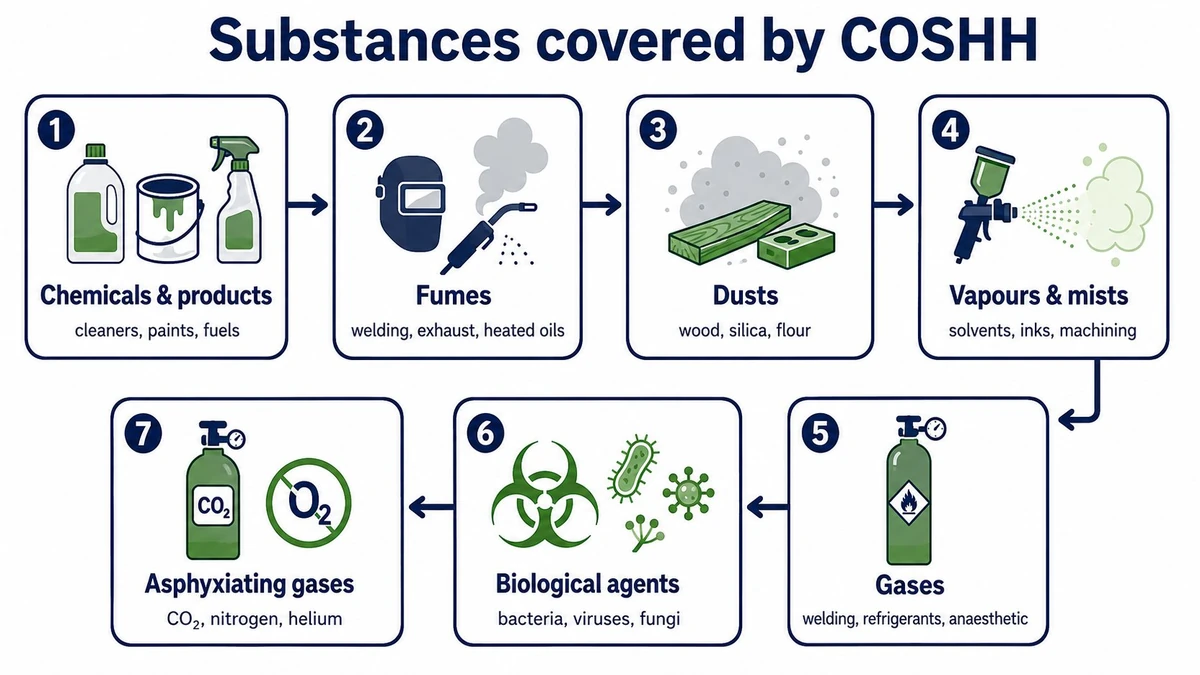
Chemicals and products containing chemicals
Cleaning products, paints, adhesives, solvents, pesticides and many other chemicals may be covered. Check the actual health hazards and use. A pictogram for a solely physical or environmental hazard does not automatically make a substance subject to COSHH.
Fumes
Welding, soldering, heating and engine processes can produce harmful fume or emissions. HSE’s 2019 alert recognised that all welding fume, including mild steel fume, can cause lung cancer. Controls depend on the task: HSE distinguishes indoor extraction and suitable RPE, including RPE for outdoor work where extraction cannot provide effective control.
Dusts
Examples include wood, silica, flour, grain and cement dust. Regulation 2 includes dust at 10 mg/m³ inhalable or 4 mg/m³ respirable concentration, averaged over eight hours. These are scope thresholds, not safe limits: harmful dusts can require control below them and may have a lower WEL.
Vapours and mists
Solvent vapours from paint, glue, fuel, cleaning fluids and printing inks. Metalworking fluid mists from CNC machining and grinding. Spray mists from agricultural and horticultural spraying. Vapours from drying processes.
Gases
Industrial gases used in welding (acetylene, argon, CO₂), refrigerant gases, anaesthetic gases in healthcare, biological gases (methane from fermentation or digestion), and asphyxiating gases.
Biological agents
Bacteria, viruses, fungi, parasites and prions that can cause infection, allergy or toxicity. The regulations cover both intentional work with biological agents (laboratory cultures, vaccine production) and incidental exposure (healthcare, sewage work, agricultural work, certain manufacturing processes). Biological agents are classified into Hazard Groups 1 to 4 in Schedule 3 of the regulations, by the severity of disease they cause and the availability of effective prophylaxis.
Asphyxiating gases
Nitrogen, helium and other gases can displace oxygen. Carbon dioxide also has harmful physiological effects at raised concentrations, so it is not merely an inert oxygen-displacer. Assess gas accumulation and confined-space risks; lack of smell does not establish safe air.
What COSHH does not cover

Regulation 5 excludes certain risks or work to the extent covered by specific regimes. Check the hazard and activity rather than assuming an entire material is outside every COSHH duty.
Asbestos
Asbestos is regulated by the Control of Asbestos Regulations 2012. Note the date — these are 2012 regulations, replacing earlier 2002 and 2006 regulations. A surprising number of guides still cite the older versions.
Asbestos work requires an assessment and appropriate controls. Licensing, notification and medical-surveillance duties depend on the type of work. Not all non-licensed work is notifiable. Medical checks are generally every two years for licensed work and every three years for notifiable non-licensed work; these are not a single interval for everyone. The duty to manage applies to relevant non-domestic premises and common parts.
HSE recorded 2,146 mesothelioma deaths in Great Britain in 2024. This is a calendar-year death count, largely reflecting asbestos exposures many years earlier, rather than an estimate of current workplace exposure.
Lead
The Control of Lead at Work Regulations 2002 require assessment and prevention or adequate control. Medical surveillance applies where exposure is or is liable to be significant, and in other specified circumstances. Blood-lead results help evaluate exposure; they do not replace adequate controls or all other assessment requirements.
Potential exposure includes battery work, recycling, lead paint removal, soldering and other work involving lead. Tradespeople working on older materials may still be exposed; do not exclude them based on occupation alone.
Radioactive substances
The Ionising Radiations Regulations 2017 address radiation risks. Required controls, area designations and notification, registration or consent depend on the activity. COSHH excludes a substance hazardous solely through radioactivity; a separate chemical health hazard may still require COSHH controls.
Radioactive substances at work include radiotherapy sources in healthcare, industrial radiography sources in non-destructive testing, naturally-occurring radioactive material (NORM) in some mining and oil and gas operations, and contamination monitoring at decommissioning sites.
Substances that fall under both COSHH and DSEAR
Many flammable substances trigger both COSHH and the Dangerous Substances and Explosive Atmospheres Regulations 2002 (DSEAR). The two regulations cover different aspects of the same substance:
- COSHH covers the health risks — inhalation of vapours, skin absorption, narcotic effects
- DSEAR covers the fire and explosion risks — vapour-air mixtures forming explosive atmospheres, sources of ignition, fire spread
For most workplaces using flammable solvents (paints, white spirit, acetone, ethanol, fuels), both sets of regulations apply. The risk assessment needs to address both — usually through a combined assessment that considers health, fire and explosion together. The L138 Approved Code of Practice covers DSEAR; the L5 ACOP covers COSHH; for substances triggering both, both ACOPs are relevant.
COSHH storage requirements covers this overlap in more detail, particularly around fire-resistant storage cabinets.
The edge cases
A few substance categories cause more confusion than the main rules suggest.

Nanomaterials
Nanomaterials can be hazardous under COSHH. Their small scale may affect behaviour and toxicity, so use HSE nanomaterial guidance and competent advice when selecting assessment methods and controls. Do not assume a conventional bulk-material limit or method fully addresses the risk.
Water
Frequent or prolonged wet work can damage the skin and cause dermatitis, especially alongside soaps and cleaners. Assess actual contact and controls rather than treating a handwashing count as a universal legal threshold.
HSE estimates 18,000 people who worked in the previous year had self-reported work-related skin problems, averaged across 2022/23–2024/25. This is a broad skin-problem estimate for Great Britain, not a count of diagnosed dermatitis or cases attributable solely to wet work.
Cleaning chemicals
Cleaning products can be hazardous to health whether or not they carry a pictogram. Consider their formulation, concentration, application and skin contact, including repeated use of soaps or washing-up liquids.
Office and DSE products
An office is not categorically outside COSHH. Assess relevant substances and tasks, including cleaning and maintenance. Routine use of a well-controlled product may present low risk, but low exposure does not by itself remove the need to consider its hazards.
Pharmaceuticals and medicines
Regulation 5 excludes the risk to a person receiving a substance in the course of their medical treatment. It does not exclude occupational exposure to that medicine during preparation, administration, disposal or other handling. For example, workers handling cytotoxic drugs still need protection.
A quick scope lookup
The following table summarises the most-asked "is X covered" questions.
| Substance | In scope of COSHH? | Notes |
|---|---|---|
| Asbestos | No | Control of Asbestos Regulations 2012 |
| Lead | No | Control of Lead at Work Regulations 2002 |
| Radioactivity-only health risk | No | Ionising Radiations Regulations 2017; other chemical risks may remain within COSHH |
| Petrol / flammable solvents | Yes (also DSEAR) | Both health and fire risks apply |
| Cement and mortar | Yes | Wet cement burns and dermatitis; respirable silica from cutting hardened materials |
| Welding fume | Yes | Control all welding fume; use the task-specific HSE guidance |
| Bleach (sodium hypochlorite) | Yes | Classification varies by product; assess contact, application and mixing risks |
| Biological agents | Yes | Schedule 3 hazard groups apply |
| Asphyxiating gases (CO₂, N₂) | Yes | Oxygen displacement; CO₂ also has direct physiological effects |
| Wet work (water exposure) | Yes | Assess frequent or prolonged contact and dermatitis risk |
| Nanomaterials | Yes | With additional assessment difficulty |
| Risk to a patient from their medical treatment | No | Regulation 5 exclusion does not remove duties towards exposed workers |
| Photocopier toner (routine office use) | Assess relevant use | Low risk does not automatically remove COSHH relevance |
Why the boundary matters
The applicable regime determines the duties. For example, some asbestos work requires a licence, significant lead exposure requires surveillance, and radiation activities have specific controls. Determine the actual activity and hazard rather than applying one generic checklist.
An incorrect scope decision can leave relevant risks uncontrolled or miss duties under another regime. Where more than one hazard exists, more than one set of regulations may apply.
Start with all substances and processes that could harm health, including those without labels. Check specific exclusions and other applicable regimes, and assess and control the risks using the correct legal framework.
For workers, knowing which substances they handle are in scope of COSHH and which carry more stringent regimes is part of the Regulation 12 training duty. That's where COSHH Training earns its place: practical recognition of substances and their applicable regimes is hard to get from a single induction document.
Frequently asked questions
Is lead covered by COSHH?
Lead health risks are governed by the Control of Lead at Work Regulations 2002 to the extent those regulations apply. Medical surveillance and blood-lead testing are required in specified circumstances, including significant exposure.
Is asbestos covered by COSHH?
Asbestos work is governed by the Control of Asbestos Regulations 2012. The type of work determines licensing, notification and surveillance requirements; not all work requires a licence.
Does COSHH cover nanomaterials?
Yes, where they can harm health. The assessment is harder than for conventional substances because measurement techniques are less mature and toxicological data is more limited.
Are biological agents covered by COSHH?
Yes. Biological agents (bacteria, viruses, fungi, parasites and prions) are explicitly within scope of COSHH, classified into four hazard groups in Schedule 3 of the regulations by severity of disease and availability of effective prophylaxis.
Is bleach covered by COSHH?
Bleach can present health risks and needs assessment for the actual product and task. Its classification varies by formulation. Never mix it with other cleaning products; incompatible mixtures can release harmful gases.
Is water covered by COSHH?
Frequent or prolonged wet work can cause dermatitis and needs assessment and control. A particular number of hand washes is not a universal statutory trigger.
What about radioactive substances?
Radiation risks are addressed by the Ionising Radiations Regulations 2017. If a radioactive material also presents a separate chemical health hazard, COSHH may apply to that hazard.
Is petrol covered by COSHH?
Yes for the health risks (vapour exposure, skin contact). Petrol is also covered by DSEAR for the fire and explosion risks. Most workplaces using petrol need both assessments.
Related guides
- COSHH Cleaning Colour Codes Explained
- The 8 Steps to COSHH Compliance
- The COSHH Hierarchy of Control: How to Choose Controls in the Right Order
Make sure your team is trained to recognise and work safely with substances hazardous to health.
Explore the COSHH Training course →Sources & references
- COSHH Regulations 2002, as amended
- HSE: substances hazardous to health
- HSE: COSHH Approved Code of Practice L5
- HSE: welding fume controls
- HSE: notifiable non-licensed asbestos work
- HSE: significant lead exposure
- HSE: work-related skin disease statistics 2025
- HSE: 2024 mesothelioma deaths, published July 2026
- HSE: nanomaterials

Mark writes about workplace health & safety, COSHH and accredited online training for COSHH Training, part of Online CPD Academy.